Poor Child Education and the Role of NGOs in India
Education is not a privilege; it is a fundamental right. For a nation like India, which aspires to be a global leader, ensuring every child has access to quality education is not just an obligation but the foundation of sustainable progress. Unfortunately, millions of children from poor families are deprived of this basic right. Poverty, child labor, gender discrimination, and lack of infrastructure continue to rob children of their childhood and opportunities.
In this mission of educating the underprivileged, Non-Governmental Organizations (NGOs) have emerged as powerful agents of change. They go beyond policies and classrooms, reaching slums, rural areas, and marginalized communities to give children the gift of learning. Their contribution to poor child education in India is immense and often life-changing.
State of Child Education in India
India has the world’s largest population of children, with over 250 million in the school-going age group. Yet, the quality and accessibility of education remain uneven.
- The literacy rate in India is about 77.7%, but there is a significant gap between urban and rural areas.
- Many children from poor households drop out before completing primary education.
- According to reports, nearly 3 crore children in India are still out of school.
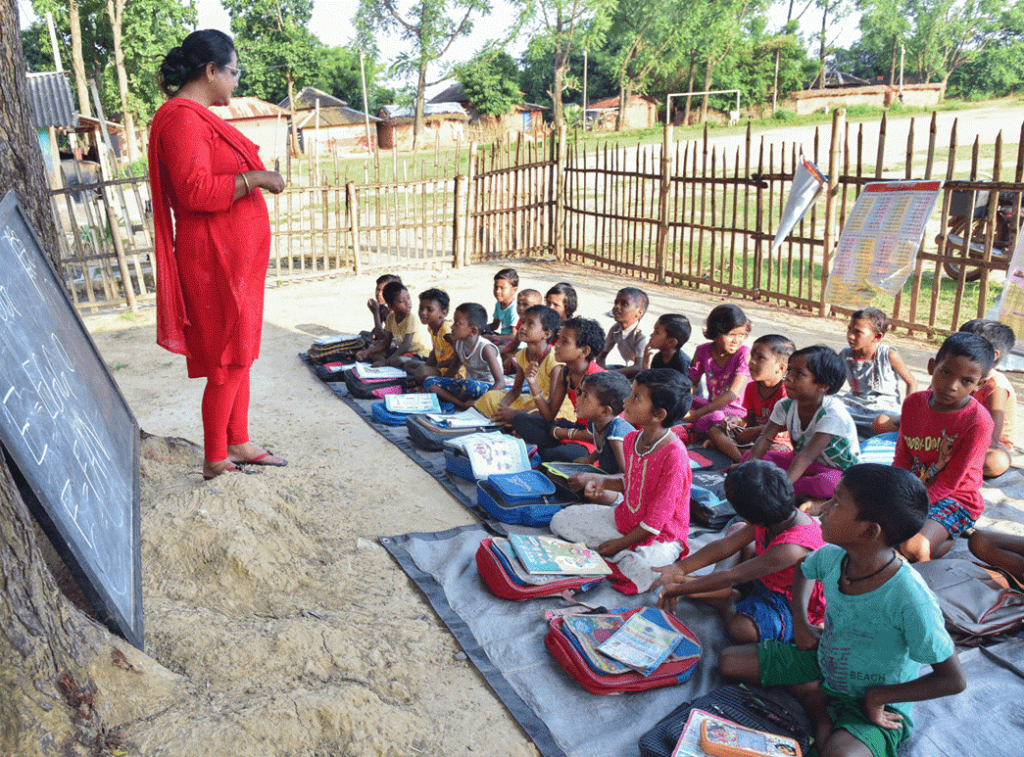
Urban children may have access to better facilities, but rural children often study in single-teacher schools, dilapidated buildings, or sometimes under trees. Education for poor children is not just about classrooms; it is about survival against odds.
Challenges Faced by Poor Children in Accessing Education
The barriers are many, and each one is deeply rooted in India’s social and economic fabric.
- Poverty & Child Labor: Families living in poverty often prioritize survival over schooling. Children are forced to work in fields, factories, or as domestic help.
- Gender Bias: Girls are often denied education due to cultural beliefs, early marriage, or household responsibilities.
- Infrastructure Gaps: Many schools lack toilets, clean drinking water, libraries, or even enough teachers.
- Quality of Teaching: Poor children often attend schools where teacher absenteeism and rote learning dominate.
- Social Barriers: Caste-based discrimination, migration of families, and lack of awareness keep children away from classrooms.
- Digital Divide: With education shifting online post-COVID, poor children without internet or devices were completely excluded.
These challenges make it clear that education for poor children cannot be achieved by government efforts alone.
Government Efforts Towards Universal Education
The Indian government has made significant strides:
- Right to Education Act (2009): Made education free and compulsory for children aged 6–14.
- Sarva Shiksha Abhiyan (SSA): Focused on universal primary education.
- Mid-Day Meal Scheme: Aimed to improve attendance and nutrition.
- Digital India programs: Promoted e-learning.
While these programs are powerful, gaps in implementation, corruption, and lack of reach to marginalized communities hinder their effectiveness.
Role of NGOs in Supporting Poor Child Education
This is where NGOs become crucial:
- Bridging the Gap: NGOs fill in where government schemes fail to reach.
- Awareness Campaigns: They convince parents of the importance of sending children to school.
- Alternative Education Models: Running evening classes, bridge schools, and community learning centers.
- Scholarships & Support: Providing books, uniforms, nutrition, and even financial aid.
- Teacher Training: NGOs often train local youth to become educators in villages.
- Community Empowerment: Involving parents, panchayats, and local leaders to create sustainable change.
Successful Models by NGOs in India
Several NGOs have transformed lives:
- Pratham: Their “Read India” program has improved basic literacy and numeracy for millions.
- Teach for India: Places fellows in under-resourced schools to improve teaching quality.
- Smile Foundation: Focuses on education through its Mission Education initiative.
- CRY (Child Rights and You): Works to eliminate child labor and promote schooling.
- Barefoot College: Empowers rural children with life skills, solar energy training, and education.
Each NGO adapts its approach depending on community needs, ensuring no child is left behind.
Impact of NGOs on Child Education
The results are visible:
- Dropout rates have reduced significantly in areas where NGOs operate.
- Literacy and confidence levels of children have improved.
- NGOs nurture creativity, leadership, and problem-solving skills, not just academics.
- Children educated by NGOs often break the cycle of poverty by entering better-paying jobs.
Education & Sustainable Development Goals (SDGs)
NGOs working for poor child education directly contribute to SDG 4: Quality Education. But their impact spills over to:
- SDG 1 (No Poverty): Education equips children to escape poverty.
- SDG 3 (Good Health): Education promotes hygiene, nutrition, and healthcare awareness.
- SDG 5 (Gender Equality): Educating girls delays marriage, reduces maternal mortality, and empowers women.
- SDG 8 (Decent Work): Educated youth join the workforce with better opportunities.
Thus, child education is the root solution to many global problems.
Stories of Transformation
Real stories inspire more than statistics.
- A boy from the slums of Mumbai, supported by Teach for India, went on to secure admission in IIT.
- A girl from a rural village in Rajasthan, helped by Barefoot College, became a solar engineer and trained other women.
- Children rescued from child labor by CRY are now pursuing higher studies and becoming community leaders.
These stories prove that investment in education is an investment in human potential.
Future Roadmap
To ensure no poor child is left behind, India needs:
- Stronger NGO-Government Partnerships: For better implementation of policies.
- Digital Inclusion: Affordable internet and devices for poor children.
- Holistic Education: Beyond academics—life skills, values, and vocational training.
- CSR Engagement: Corporate funding to scale NGO efforts.
- Focus on Marginalized Groups: Disabled children, tribal communities, and migrant labor families.
Conclusion
Education is the single most powerful tool to break the cycle of poverty. Poor child education in India is not just about literacy—it is about dignity, opportunities, and dreams. NGOs have proven to be the lifeline for millions of children who would otherwise remain invisible in statistics.
As citizens, corporates, and communities, it is our responsibility to support NGOs in their mission. Every rupee donated, every hour volunteered, and every child enrolled in school brings India one step closer to equality and progress.
Let us remember: when a poor child gets educated, it is not just one life that changes, but an entire generation that rises.